

Thick plate and structural welding can be demanding work. In shipyards, heavy fabrication shops, and other high-production environments, welders may spend hours making long welds at high amperages. The torch needs to keep up with that workload without making the job harder on the person using it.
There are several things to look at when choosing a MIG torch for this type of work. Heat management is important, but so are torch weight, ergonomics, access to difficult joints, consumable service life, and how quickly consumables and other components can be replaced.
The right torch ultimately comes down to matching its design to the application. Here are a few of the features worth considering when comparing MIG torches for thick plate and structural welding.
-Sep-04-2026-01-05-15-2003-PM.png?width=800&height=229&name=Untitled%20design%20(1)-Sep-04-2026-01-05-15-2003-PM.png)
Managing Heat in High-Amperage Welding
Heat is one of the first things to consider when a MIG torch will be used for high-amperage welding. Long welds and high deposition rates can put a lot of heat into the torch, especially when it is being used throughout a full shift. Without adequate cooling, that heat can contribute to faster consumable wear and more frequent interruptions.
For demanding applications like these, a water-cooled torch may be the better choice. Water cooling helps move heat away from the torch and consumables, making it well suited for applications that require high output over extended periods.
-Sep-04-2026-01-21-15-6852-PM.png?width=287&height=287&name=Untitled%20design%20(2)-Sep-04-2026-01-21-15-6852-PM.png)
The ABIMIG® WT 540, for example, is rated for up to 600 A with CO₂ or 550 A with mixed gas at a 100% duty cycle. That makes it a good fit for applications where the torch needs to handle high amperage for long periods.
The cooling design itself is also worth looking at. On the ABIMIG® WT, water cooling extends through the front of the torch neck to help manage heat around the consumables. Keeping this area cooler can help reduce wear on components such as contact tips and nozzles.
Spatter is another challenge in heavy welding. Thick plate applications can produce a significant amount of spatter, which can build up around the nozzle and torch neck. Nickel-plated components can help resist this buildup, while the WT also uses an integrated, replaceable spatter protector inside the nozzle.
When comparing torches for high-amperage welding, don't focus only on the maximum amperage rating. Duty cycle, cooling design, consumable life, and the conditions the torch will actually be used in are all important parts of the equation.
Reducing Operator Fatigue Without Sacrificing Power
The weight of a welding torch may not seem like a major consideration at first, but it becomes much more important when a welder is using it for hours at a time.
In heavy fabrication, welders may be moving around large structures, climbing scaffolding, or working in positions that are difficult to maintain for long periods. A lighter torch and cable can make those jobs easier to handle without giving up the power needed for the application.
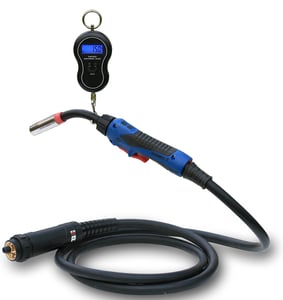
This is where an air-cooled torch can make sense when water cooling isn't possible. The ABIMIG® AT combines an air-cooled design with a lightweight BIKOX® LW cable, making the torch up to 50% lighter than comparable standard MIG guns.
Less weight can be especially noticeable over the course of a full shift. The AT also features a ball-and-socket connection at the base of the handle, allowing the torch and cable to move more freely as the welder changes position. Both the ABIMIG® AT and ABIMIG® WT also feature a long trigger that allows the welder to keep their hand farther away from the heat while welding. This can be especially useful during long welds, when even small ergonomic advantages can make a difference over the course of a shift.
When comparing MIG torches, amperage and duty cycle aren't the only specifications that matter. The torch also needs to be comfortable to hold and maneuver. If a welder is constantly fighting the weight or stiffness of the torch, that can become a problem long before the weld itself does.
Flexibility for Difficult-to-Reach Weld Joints
Not every weld joint is easy to access, particularly when working on large structural components. A torch setup that works well for one joint may not be ideal for the next.
Having the ability to change the torch neck can give welders more flexibility without requiring an entirely different torch.
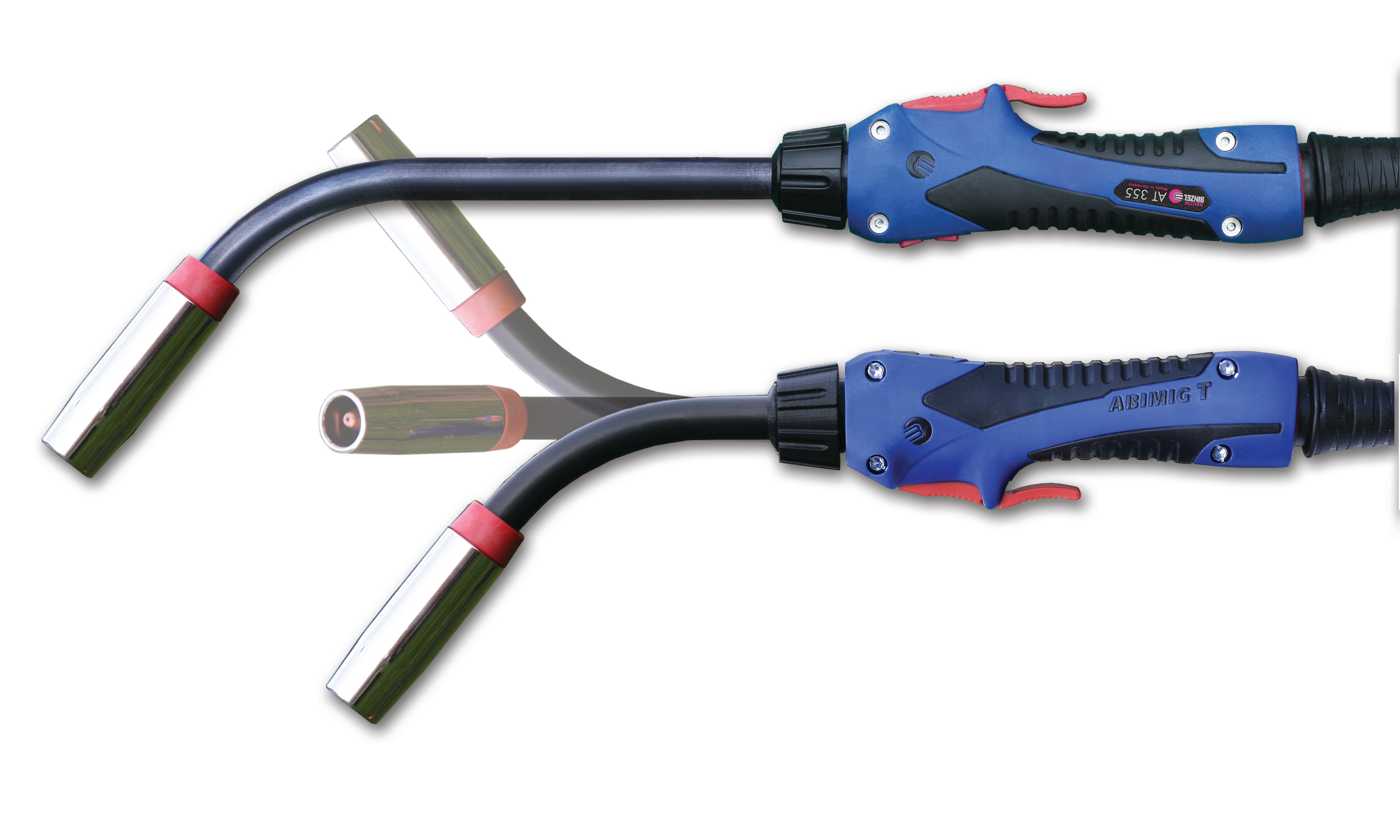
Both the ABIMIG® AT and ABIMIG® WT feature a turnable, exchangeable neck. The neck can be rotated 360° and changed without tools, allowing the welder to adjust the torch to the position needed for the job.
Different neck lengths and configurations, including 45°, 60°, and 180° options, can also help improve access to different joint geometries. Choosing the right neck length allows welders to position the torch more comfortably instead of having to put themselves into awkward positions to reach the joint. This can be especially helpful in heavy fabrication, where welds can be long and welders may need to maintain the same position for extended periods.
There can also be an inventory benefit for fabrication shops. Instead of keeping a complete torch assembly for every welding position, different neck options can be kept on hand and used with the same basic torch and cable setup.
For structural welding, where joint access and welding position can change throughout the job, that flexibility can be just as important as the torch's amperage rating.
Choosing the Right MIG Torch for the Job
There isn't one MIG torch that is right for every thick plate or structural welding application. The right choice depends on how the torch will be used, how much heat it will be exposed to, how long it will run, and what the welder needs to work comfortably.
.png?width=361&height=206&name=Untitled%20(700%20x%20400%20px).png) For high-amperage applications with long, continuous welds, a water-cooled torch such as the ABIMIG® WT can provide the cooling capacity needed to handle the workload. For applications where reducing torch weight and improving maneuverability are higher priorities, an air-cooled torch such as the ABIMIG® AT may be a better fit.
For high-amperage applications with long, continuous welds, a water-cooled torch such as the ABIMIG® WT can provide the cooling capacity needed to handle the workload. For applications where reducing torch weight and improving maneuverability are higher priorities, an air-cooled torch such as the ABIMIG® AT may be a better fit.
Both designs also offer an exchangeable, turnable neck, giving welders more flexibility when working around difficult joints and changing welding positions.
The best MIG torch isn't necessarily the one with the highest amperage rating or the most features. It's the one that matches the work being done and makes it easier for the welder to do that work consistently, shift after shift.
Don’t let the wrong torch slow down production or put unnecessary strain on your welders. Explore the ABIMIG® series to find the right solution for your high-amperage applications, or contact our team to discuss the best setup for your next project.
Ready to learn more? Check out these videos!